Stop Buying Overpriced Carbon Wheels
Why the Trail One Shed wheelset hits the sweet spot between cheap stock wheels and a $2,000 carbon upgrade.
WORDS AND RIDE IMPRESSIONS BY JARED HOFF
Upgrading the wheels on your mountain bike always seems to come with a catch. The stock wheels that come on a lot of bikes leave you wanting more performance, but once you start looking at premium replacements, it is easy to end up staring at wheelsets that cost $2,000 or more.
There is no doubt that the right wheel and tire setup can make a huge difference. I have said for years that wheels and tires are two of the biggest upgrades you can make to a mountain bike because you can actually feel the change on the trail. The bike can accelerate differently, track differently, carry speed differently, and give you more confidence when the terrain gets rough.
The problem is that mountain bikers get sucked into the idea that premium automatically means expensive carbon. That usually leaves us in one of two camps. You either say screw it and keep riding the stock wheels because the upgrade costs too much, or you buy the $2,000 wheelset and spend the next few months trying to convince yourself and all your friends that it was worth every penny.
I think there is a much better middle ground. After racing more than 27 miles of rocky terrain at the Shed Enduro on a set of Trail One Shed aluminum wheels that costs less than $1,000, I came away thinking this might be the ultimate Goldilocks wheelset. It is not cheap, but it is also nowhere near the cost of a high-end carbon setup. More importantly, it gets the things that actually matter on the trail right.
I have been riding and reviewing bikes for years. I have tested aluminum against carbon, spent my own money on fancy carbon wheelsets, and gone pretty far down the rabbit hole of expensive hubs, spokes, and rims. If I could boil down what I have learned into a simple checklist, I would look at three things: the engineering, the balance between compliance, strength, and weight, and the actual value you are getting for the price.
1. Engineering matters more than the material
A lot of us start by looking at the material. Carbon is premium. Aluminum is the cheaper compromise. That is how the industry has trained us to think about wheels, but it misses most of what actually makes a good wheelset. The shape of the rim, the spoke tension, the spoke count, and the way the whole wheel is built matter at least as much as the word printed on the material spec.
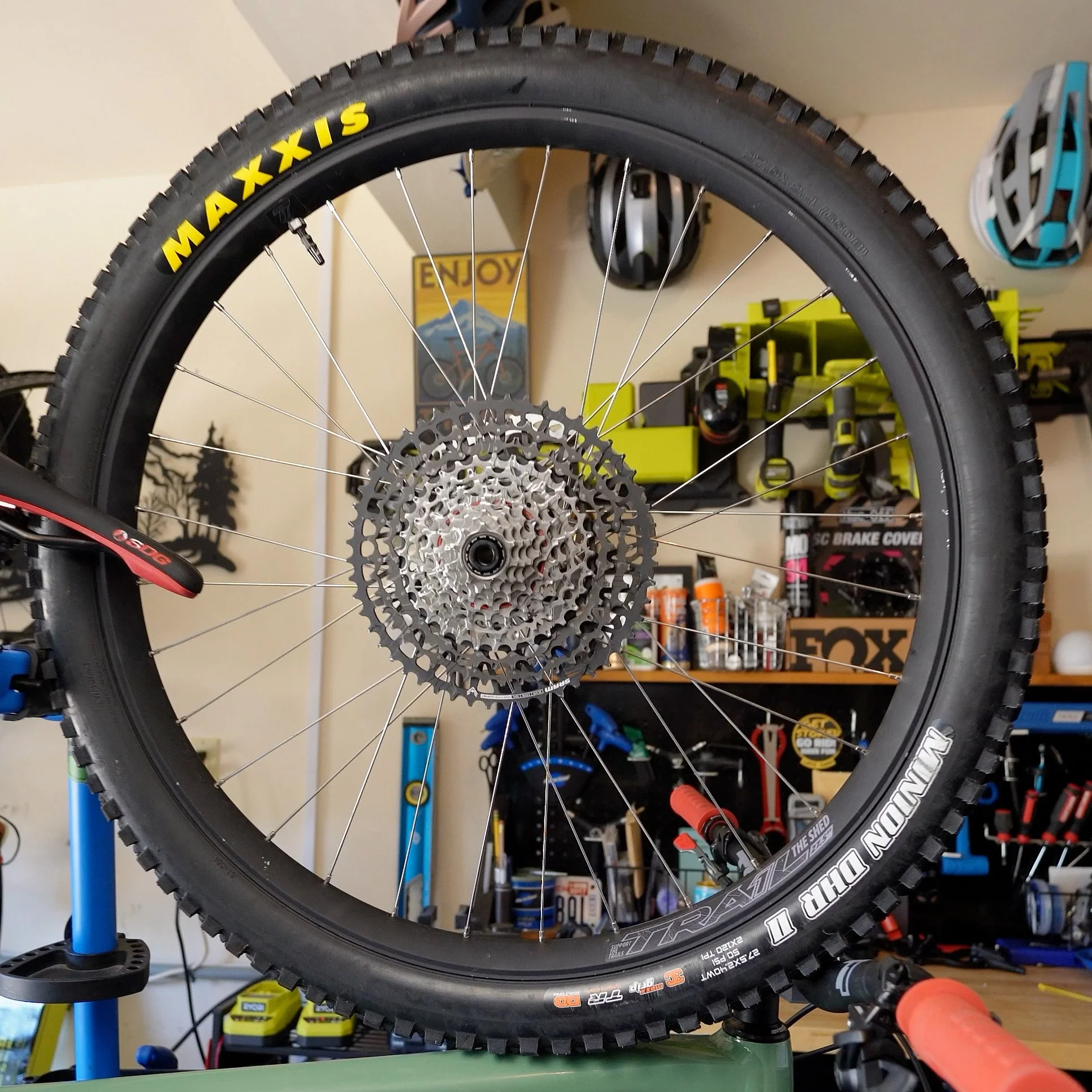
The Shed rim uses 6061 aluminum with a fairly shallow rim profile. That shallow shape is intentional because it allows a little more natural compliance instead of making the wheel unnecessarily deep and stiff. The rim also has a wide 3.5mm lip designed to resist dents and help prevent pinch flats when your tire gets slammed into a rock.
The asymmetric profile is money
The rim has a 4mm asymmetric profile, which basically means the spoke holes sit a little off center. That might sound like a small detail, but it helps the wheel builder get more even spoke tension from one side of the wheel to the other. A modern 12-speed cassette takes up a lot of room on the drive side of the rear hub. If the rim and spoke bed were perfectly centered, the spokes would need very different tension on each side to keep the wheel straight. Moving that spoke bed over helps balance things out and creates a stronger, more stable wheel.
That matters on a big enduro bike, but modern trail bikes and even a lot of shorter-travel bikes are so capable now that they can benefit from the same kind of wheel engineering. Bikes are getting ridden harder, tires are getting pushed at lower pressures, and wheels are taking bigger hits than they used to.
Balanced from front to rear
Trail One uses 28 spokes up front and 32 in the rear. The front wheel gets a little more compliance, while the rear wheel gets the extra stiffness and strength it needs to handle more rider weight, drivetrain forces, and square-edge impacts. So the wheels are not only balanced from left to right through the asymmetric rim, but also from front to rear through the spoke count.
My test set used good-looking silver spokes laced to a silver Industry Nine hub. The current premium option is the Industry Nine Hydra 2, with 870 points of engagement. The pickup is almost immediate, which feels great when you are ratcheting through technical sections or trying to get one quick pedal stroke between rocks. Trail One also offers more value-focused Industry Nine 1/1 and DT Swiss 350 DEG builds if you do not need the most aggressive engagement.
During that 27-mile enduro race, the wheels basically disappeared beneath me. That is what I want from a good wheelset. I was not thinking about spoke tension or rim profiles while I was riding. I just felt confident enough to plow through the chunk and focus on the race.
2. Compliance, strength, and weight all matter
Carbon wheels are usually sold on two big points: they are lighter and they are stiffer. Both of those things can be good, but neither one tells the whole story about how a mountain bike wheel feels on the trail.
Weight definitely matters. A lighter wheel spins up quicker, and because wheel weight is unsprung and rotating, it can affect the way the suspension and bike respond. But a heavy-duty trail or enduro carbon rim still needs a decent amount of material to survive real riding. The difference between a tough carbon wheel and a tough aluminum wheel is often a couple hundred grams, not some massive night-and-day number.
For me, compliance and strength matter more than chasing the lowest possible number on a scale. I have ridden very stiff carbon wheels that felt awesome on smooth flow trails, berms, and jumps. But once the trail turned into a long rock garden, that same stiffness left my hands and arms feeling beat up. A little bit of controlled flex can make a wheel feel calmer and more comfortable without making it vague.
That is one of the reasons the shallow profile of the Shed rim makes sense. It is still a heavy-duty rim, but it is not trying to be as rigid as possible just so the marketing copy can call it stiff. It has some give built into the shape, which helps take the edge off trail vibration and repeated impacts.
Carbon is stronger, right up until it is not
I have seen the strength advantage of carbon firsthand. I was riding behind a friend when we both hit basically the same rock and blew out our tires. His aluminum rim was dented. My carbon rim did not even have a visible scratch. Carbon can absolutely handle a hard initial hit better than aluminum.
The difference shows up when each material reaches its breaking point. Aluminum normally dents or bends. Sometimes you can straighten it enough to reseat the tire and finish the ride. When a carbon rim finally breaks, it cracks, and that can mean a complete failure with no practical trailside fix.
That matters to me in a long race or a big backcountry ride. I do not want to deal with a warranty claim while I am standing 15 miles from the finish line. I want a rim that gives me a chance to get the tire holding air and keep moving.
At the Shed Enduro, I ran my tire pressure low enough to get good grip in the rocks. A few times I heard the tire bottom out and ding the rim. With that wide 3.5mm rim lip, I did not dent the rim and I did not pinch flat the tire. I just kept mobbing. That one race does not prove the wheel is indestructible, but it is exactly the kind of real-world hit the rim was designed to handle.
There still has to be a balance. A wheel cannot be so soft that it feels inaccurate, and it cannot be a boat anchor just because it is strong. The point is not that aluminum automatically beats carbon. The point is that a properly engineered aluminum wheel can hit the right balance of compliance, strength, and reasonable weight without
3. Price matters, but value matters more
If money were no object, choosing bike parts would be easy. Go to the shop, buy the most expensive bike and the most expensive upgrades, and there is a good chance they will perform really well. You would not need articles or videos like this one.
For the rest of us caged in reality, price matters. More importantly, we have to look at what we are actually getting for that price. The wheelset I tested came in at $999 with the high-engagement Industry Nine setup. That is obviously not cheap, but it is less than half the price of plenty of premium carbon wheelsets, and it still gives you a rim built for hard riding, a quality hub, a thoughtful spoke setup, and a wheel that feels properly premium on the trail.
There are cheaper aluminum wheels, lighter aluminum wheels, and carbon wheels with excellent warranties. I am not saying the Shed is the only good choice or the perfect choice for every rider. I am saying this specific combination lands in a really smart middle ground. You are spending enough to get a wheelset that can genuinely change the way your bike rides, but you are not paying an extra thousand dollars just to get carbon rims.
A crash policy that makes sense
Trail One backs its products with a lifetime manufacturing warranty and crash replacement program. Manufacturing defects are covered for the original owner. If you damage a Shed rim in a crash or rock strike badly enough that it can no longer hold air, Trail One offers the original owner a replacement rim at 60% off.
That does not make a broken wheel fun, and it does not pay for every spoke or the labor to rebuild it. But it makes the worst-case cost a whole lot easier to swallow. More importantly, the alloy rim gives you a decent chance of finishing the ride before you ever have to use that policy.
The purchase gives something back
The other part I like is the Trail One Treasury. Trail One sets aside $1 from every product sold to support mountain bike trails. Products named after a specific riding area send that money back to the organization supporting that place. The Shed wheels support the Mid-Atlantic Off-Road Enthusiasts, which helps build, maintain, and advocate for the Frederick Watershed trails where I raced these wheels.
I know one dollar by itself is not rebuilding an entire trail system, but I like that the giveback is tied to every sale and to the actual place behind the product name. Mountain bike components do not mean much without great trails to use them on, so it is cool to see a brand treat trail support as part of the product instead of an occasional marketing campaign.
So, who are these wheels actually for?
I think the Shed makes the most sense for the rider who has reached the limit of a cheap stock wheelset and wants a real upgrade, but does not want to spend $2,000 chasing carbon. Maybe you have a trail bike and want to make it more capable in rough terrain. Maybe you have an enduro bike and want a dependable wheelset with a premium hub. Maybe you are just tired of treating aluminum like the option you settle for.
If your main goal is the lowest possible weight, these probably are not your wheels. If you love the precise feel of carbon and do not mind paying for it, there are some incredible carbon options. But if you care most about durability, compliance, easy serviceability, and getting a lot of performance for the money, the Shed is a hard wheelset to ignore.
Final thoughts
The more bike parts I test, the less interested I am in choosing something just because it is the lightest, stiffest, or most expensive. A good component should make sense as a complete package and then disappear underneath you when you ride. That is what these wheels did for me.
The Shed wheelset combines a well-thought-out aluminum rim, a wide impact-resistant lip, balanced spoke counts, even spoke tension, quality hub choices, and a strong replacement policy. Then it adds a direct contribution to the trails that inspired the name. For $999 in the configuration I rode, that is about as close to the mountain bike wheelset Goldilocks zone as I have found.
What matters most to you when choosing a wheelset: the engineering, the balance of compliance and strength, or the price and long-term value? And if you have found another wheelset that puts all three together this well, I want to hear about it.
LINKS
1. Trail One Shed Wheelset https://trailone.bike/products/the-shed-wheelset?variant=48614154535117
2. Trail One Shed Rim https://trailone.bike/products/the-shed-rim
3. Warranty and Crash Replacement https://trailone.bike/pages/lifetime-warranty
4. Trail One Treasury https://trailone.bike/blogs/the-trail-one-treasury
5. MORE and the Frederick Watershed https://more-mtb.org/products/frederick-watershed
6. Watch the full wheelset video https://youtu.be/nUWWPtOs-Kk